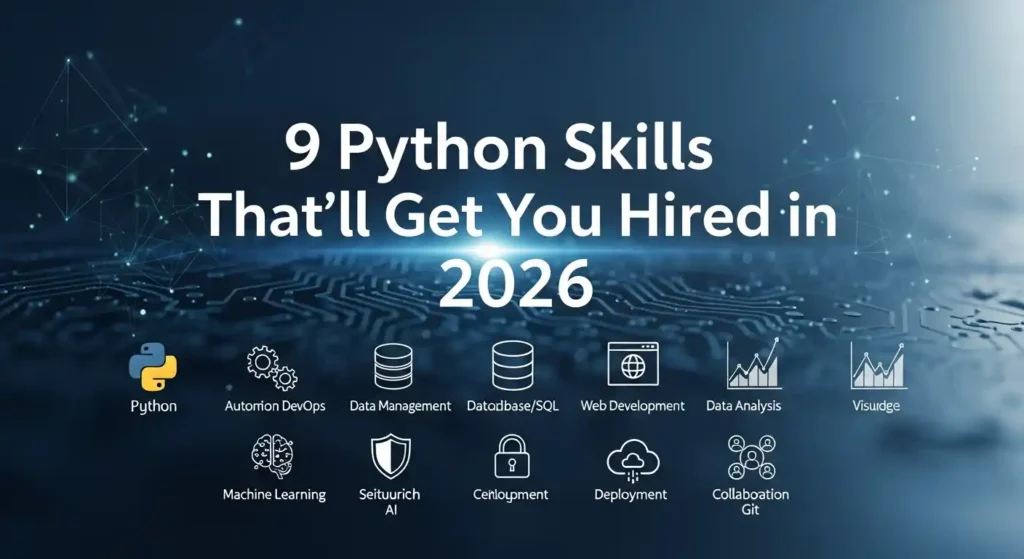

The Python job market has changed—and fast.
Companies don’t care how many certificates you’ve collected. They care about one thing only: can you build real, production-ready systems?
If you’re serious about getting hired in 2026, these are the Python skills that actually matter.
1. Building Production-Ready APIs (FastAPI & DRF)
Forget outdated Flask tutorials.
Modern companies expect you to:
- Build REST APIs with FastAPI or Django REST Framework
- Auto-document APIs using Swagger / OpenAPI
- Validate requests with Pydantic
Bonus points if you understand:
async/await- Uvicorn or Gunicorn
- Basic API security and rate limiting
If you can do this well, you’re already ahead of most applicants.
2. Data Engineering & Scalable Data Pipelines
Everyone learned pandas during the pandemic.
Now companies need engineers who can move and transform data at scale.
Key skills:
- Workflow orchestration with Airflow, Prefect, or Dagster
- Big data processing using PySpark
- Analytics engineering with dbt
- Databases like PostgreSQL, Snowflake, or BigQuery
This is one of the fastest-growing Python career paths right now.
3. Applied AI & LLM Integration
You don’t need a PhD to work in AI.
If you can:
- Integrate OpenAI or Claude APIs
- Build AI workflows using LangChain or LlamaIndex
- Deploy models with Hugging Face Transformers
- Use vector databases like ChromaDB or Pinecone
…you’re extremely valuable.
Companies don’t need AI theory—they need AI products that ship.
4. Docker, CI/CD & Production Deployment
Code that only works on your laptop doesn’t count.
You should know:
- Docker (non-negotiable)
- Basic Kubernetes concepts
- CI/CD with GitHub Actions or GitLab CI
- Infrastructure as code using Terraform
This is what separates hobby projects from real systems.
5. SQL, Databases & Caching
Not glamorous—but incredibly powerful.
Many Python developers can’t write a proper JOIN.
You should be comfortable with:
- PostgreSQL or MySQL
- SQLAlchemy + Alembic migrations
- Redis for caching
- MongoDB or DynamoDB for NoSQL use cases
Mastering databases alone can double your value.
6. Testing, Linting & Code Quality
Companies are done with “it works on my machine.”
Professional Python means:
- pytest (properly)
- coverage.py for coverage tracking
- Black or Ruff for formatting
- Pylint / Flake8 for linting
- mypy for type safety
- pre-commit hooks for automation
Boring? Maybe.
But this is what pros do.
7. Cloud Fundamentals (Pick One and Go Deep)
You don’t need to master every cloud.
Pick one:
- AWS: S3, EC2, Lambda, RDS (+ boto3)
- Azure: Blob Storage, Functions, App Service
- GCP: Cloud Storage, Cloud Functions, BigQuery
Serverless tools like Zappa or Chalice are big bonuses.
8. Async Python & Performance Optimization
Speed matters.
You should understand:
asynciofundamentals- aiohttp for async HTTP calls
- Celery or RQ for background jobs
- When to use threading, multiprocessing, or async
Developers who make systems faster are always in demand.
9. Data Visualization & Developer Demos
Stakeholders love visuals.
Beyond pandas, learn:
- NumPy for numerical work
- Polars for high-performance data processing
- Matplotlib & Seaborn
- Plotly or Dash for interactive dashboards
- Streamlit or Gradio for fast demos
Clear visuals turn engineers into decision-makers.
Quick Start Paths (Choose One)
If you’re starting, don’t overthink it:
- FastAPI + PostgreSQL + Docker + pytest → Backend-ready
- pandas + Airflow + dbt + Snowflake → Data-engineering ready
- LangChain + FastAPI + ChromaDB + Streamlit → AI-product ready
Pick a path.
Build something real.
That’s how you get hired in 2026