AI

Ordinary Least Squares

Most likely, you have previously encountered a trendline on a scatter plot. Through a cloud of dots, that straight line? It was unable to guess its destination. It was calculated. The basis of almost all basic regression models in statistics, economics, and data science is a computation known as Ordinary Least Squares (OLS). What is OLS, really? Imagine attempting to forecast website traffic using the number of social media shares a post receives. You gather fifty data points. Plotting them reveals a distinct increasing tendency, even though they don’t form a perfect line. The straight line that best matches those locations is found using OLS. “Best” refers to reducing the overall squared distance between each actual data point and the predicted line. That line looks like this: Where: Why “Least Squares”? Because OLS doesn’t just add up the errors (predicted vs. actual). It squares them first. Why? The result? One mathematically unique line that minimizes the total squared error. What OLS gives you When OLS works beautifully (and when it doesn’t) Works well when: Fails badly when: A real-world example Let’s say you run a small online store. You regress daily sales (( y )) on daily ad spend (( x )). OLS tells you: “For every $1 you spend on ads, sales increase by $4.20.” That’s gold. Now you know whether ads are profitable. The bottom line OLS is not fancy. It’s not deep learning. It won’t win a Kaggle competition on messy image data. But for understanding relationships, making simple predictions, and explaining results to a boss or client, OLS is still one of the most powerful tools you can learn. It fits on a single line of Python (statsmodels or scikit-learn), R (lm()), or even Excel.

Ordinary Least Squares Read More »

Claude Code: Your AI Pair Programmer in the Terminal

If you’ve ever wished you had a brilliant coding teammate available who knows your entire codebase inside and out, Claude Code might be exactly what you’ve been looking for. Built by Anthropic, Claude Code is an agentic coding tool that lives right in your terminal — no fancy GUI, no context-switching, just you, your code, and an AI that actually understands what you’re building. What Exactly Is Claude Code? Claude Code is more than an autocomplete engine or a fancy search bar. Think of it as a hands-on AI developer that you chat with using plain English. It reads your project files, understands the context of your codebase, and can make real changes — write functions, fix bugs, refactor legacy code, handle Git workflows, and explain complex modules — all without you leaving the terminal. Ask it: “Create an async function that fetches user data from the /api/users endpoint,” and it won’t just suggest something — it’ll write it, put it in the right file, and move on to the next task. This is powered by Anthropic’s Claude models (Opus 4.6, Sonnet 4.6, and Haiku 4.5), which means Claude Code inherits their ability to reason through multi-step tasks, handle nuanced instructions, and engage in real back-and-forth conversation. Platform Compatibility: Where Does Claude Code Run? One of the best things about Claude Code is how broadly compatible it is. It’s not locked to a single ecosystem. 1. Operating Systems Claude Code runs natively on all three major platforms: 2. Shells Supported Claude Code works with the shells developers actually use: On Windows, Git for Windows is required for native use. Claude Code uses Git Bash internally to run shell commands, so you don’t need to run PowerShell as Administrator. 3. IDEs & Editors Claude Code is not tied to any single editor. You can use it standalone in your terminal, or deeply integrated via native extensions: AI Model Compatibility Claude Code supports multiple Claude models, giving you flexibility depending on your needs and budget: Cloud Provider Compatibility Enterprise teams aren’t limited to Anthropic’s own infrastructure. Claude Code integrates with: This is a huge deal for organizations that need to keep data within specific cloud environments or already have negotiated cloud contracts. MCP (Model Context Protocol) Servers Claude Code supports MCP servers, which lets it extend its capabilities using your own tools — like connecting to GitHub’s MCP server to interact with pull requests, issues, and repositories directly. Enterprise teams can even configure a managed MCP allowlist/denylist for governance and security. Account Compatibility: Who Can Access Claude Code? Claude Code requires one of the following Anthropic account types: ⚠️ The free Claude.ai plan does not include Claude Code access. Installation Compatibility Recommended: Native Installer The preferred method is the native binary installer — it’s faster, requires no dependencies, and auto-updates in the background. Alternative: npm (Legacy) If you need npm for compatibility reasons, Node.js 18+ is required. Note that npm installation is now deprecated in favor of the native installer. Package Managers Linux Special Cases For Alpine Linux and other musl/uClibc-based distributions, you’ll need libgcc, libstdc++, and ripgrep installed via your package manager, plus set USE_BUILTIN_RIPGREP=0. What Can Claude Code Actually Do? Beyond being compatible with your setup, Claude Code handles the full development lifecycle: Writing & Generating Code: New functions, components, boilerplate, unit tests — all from natural language descriptions. Debugging: Describe the error, and Claude Code digs through relevant files to find and fix the root cause. Refactoring: Clean up legacy code, improve performance, and improve readability without breaking existing functionality. Git Workflows: Commit messages, branch management, PR summaries, all from the terminal. Codebase Explanation: Ask it to explain what a module does, trace a data flow, or summarize an unfamiliar project. Huge time-saver for onboarding. Multi-Agent Collaboration: Claude Code now supports experimental agent teams, where multiple AI agents can collaborate on complex tasks with a team lead and shared task lists. A Note on Privacy & Security Claude Code runs locally in your terminal and communicates directly with model APIs — there’s no backend server or remote code index. Before making any changes to your files or running commands, it asks for your permission. Sandbox mode (available on Linux and macOS) adds an extra layer of security by restricting what Claude Code can do without approval. Final Verdict Claude Code is one of the most compatible AI coding tools available today. Whether you’re on macOS, Linux, or Windows; using VS Code, JetBrains, or a plain terminal, running on Anthropic’s infrastructure or your own AWS Bedrock environment Claude Code meets you where you are. If you live in the command line and want an AI partner that truly understands your codebase (not just autocompletes your next line), Claude Code is worth trying. Just make sure you have a Pro, Max, Teams, Enterprise, or Console account to get started.

Claude Code: Your AI Pair Programmer in the Terminal Read More »

Where We Stand: Anthropic, the Military, and Two Lines We Won't Cross

Where We Stand: Anthropic, the Military, and Two Lines We Won’t Cross

We’ve built AI for the U.S. military, and we’re proud of it. But the Pentagon is now asking us to remove safeguards we believe protect American lives and democracy. Here’s why we said no. Published February 26, 2026 First, some context: we’re deeply committed to national defense Anthropic believes that AI is one of the most important technologies in the world right now, and that the United States and its democratic allies need to lead in developing it safely. That’s not just talk. We’ve put it into action. We were the first frontier AI company to deploy our AI on classified U.S. government networks. The first to bring it to the National Laboratories. The first to build custom AI tools for national security customers. Today, our AI Claude is used across the Department of Defense for things like intelligence analysis, military planning, cybersecurity, and more. We’ve also made real financial sacrifices for national security. We turned down hundreds of millions of dollars in revenue by cutting off access to Claude for companies connected to the Chinese Communist Party. We’ve fought back against CCP-sponsored cyberattacks on our systems. And we’ve publicly supported export controls on advanced computer chips to help keep America ahead. We are not anti-military. We are not trying to run the Pentagon. Military decisions belong to the military — not us. So what’s the dispute? The Department of Defense is now saying it will only work with AI companies that agree to allow any lawful use of their AI, which means removing two specific safeguards we have in place. Those two safeguards cover situations where we believe AI, right now, does more harm than good, even for national security. The Pentagon wants them gone. We’ve refused. And they’ve threatened serious consequences. The two things we won’t do: 1. Enable mass surveillance of American citizens2. Powerfully autonomous weapons that remove humans from life-or-death decisions Why we won’t allow mass domestic surveillance We fully support using AI for lawful intelligence work — tracking foreign threats, countering espionage, and protecting national security. That’s legitimate and important. But “mass domestic surveillance” is something different. It means using AI to automatically monitor the movements, web browsing, and personal associations of ordinary Americans, at a massive scale, without warrants, and without most people knowing it’s happening. Here’s something that might surprise you: this is currently legal in the United States. The government can buy detailed records about Americans from commercial data brokers without a warrant, because the law hasn’t kept up with modern technology. Even the intelligence community has admitted this raises serious privacy concerns, and there’s bipartisan pushback in Congress. Powerful AI makes this vastly more dangerous. Scattered pieces of data that seem harmless on their own, a location ping here, a website visit there — can now be stitched together by AI into a detailed portrait of any person’s life, automatically and at a scale that was never before possible. That’s a threat to the very democratic values we’re supposedly trying to defend. We won’t build that system. Why we won’t have powerfully autonomous weapons yet This one is more nuanced. We’re not opposed to autonomous weapons in principle. “Partially autonomous” weapons systems that assist human soldiers but keep a person in the decision loop are already being used effectively in conflicts like the war in Ukraine. We support that. “Fully autonomous” weapons are different. These are systems that would select a target and pull the trigger — or drop the bomb — entirely on their own, with no human making that final call. We believe this may eventually be necessary for national defense. But today’s AI, including ours, simply isn’t reliable enough for that responsibility. The errors AI makes can be catastrophic when the stakes involve human lives. Our professional military applies judgment, ethics, and accountability that AI systems today cannot replicate. “We will not knowingly provide a product that puts America’s warfighters and civilians at risk.” We’ve offered to work directly with the Department of Defense on research to improve AI reliability for these applications. They declined. But our position stands: fully autonomous lethal weapons need better AI than exists today, and proper oversight guardrails that don’t yet exist. We won’t deploy something we believe is unsafe. What the Pentagon threatened and why it doesn’t change our answer The Department of Defense hasn’t just asked us to reconsider. They’ve made specific threats: They said they will remove Anthropic from their systems if we keep these safeguards. They’ve also threatened to label us a “supply chain risk” — a designation that has only ever been used for foreign adversaries, never for an American company. And they’ve threatened to invoke the Defense Production Act to force us to comply. We noted the contradiction ourselves: you can’t simultaneously claim that we’re a national security risk and that our AI is essential to national security. Both can’t be true. But regardless of the threats, our answer is the same. We can’t in good conscience agree to their request. What happens now It’s the Pentagon’s right to choose which companies they work with. We respect that. Our strong preference is to keep working with the Department of Defense and the men and women who serve, just with these two safeguards in place. If they decide to remove us, we will do everything we can to make the transition smooth. We won’t leave warfighters without support. Our models will remain available under the generous terms we’ve proposed for as long as needed. We believe deeply in American security. We believe in democracy. And we believe that sometimes defending those values means saying no — even to the people asking in their name. We remain ready to serve. This post is adapted from Anthropic’s official statement to the Department of Defense, dated February 26, 2026.

Where We Stand: Anthropic, the Military, and Two Lines We Won’t Cross Read More »

What is a Vector Database

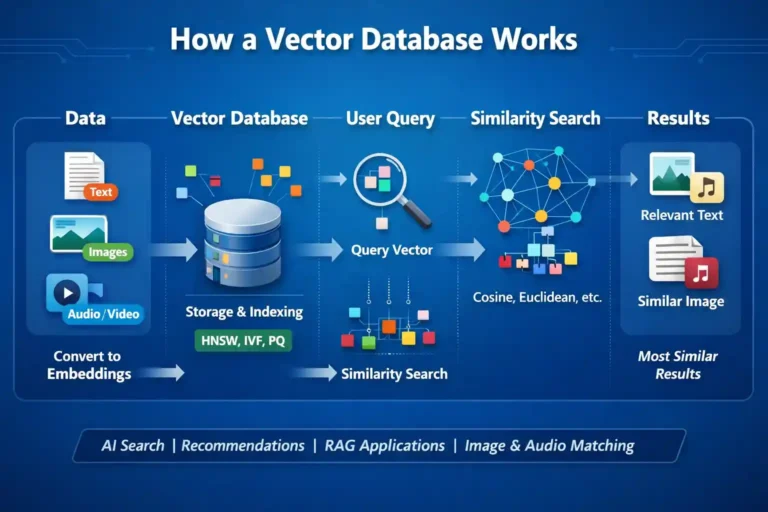
What is a Vector Database & How Does it Work?

I’ve been diving deep into the world of AI and machine learning lately, and one technology that keeps popping up everywhere is vector databases. At first, I’ll admit, the concept seemed pretty abstract and technical. But once I understood what they actually do and why they matter, everything clicked. So let me break it down for you in the simplest way I can. The Problem Vector Databases Solve Think about how traditional databases work. You store data in rows and columns, and when you want to find something, you search for exact matches or use filters. If I’m looking for a customer named “John Smith,” the database finds exactly that name. Simple, right? But here’s where it gets interesting. What if you want to find things that are similar but not identical? What if you’re building an AI application that needs to understand meaning, context, and relationships between data? Traditional databases aren’t built for that. That’s where vector databases come in. What Exactly is a Vector Database? A vector database is a specialized type of database designed to store and search through high-dimensional vectors. Now, I know “high-dimensional vectors” sounds intimidating, but stick with me. A vector is essentially just a list of numbers that represents something. Think of it as coordinates in space, but instead of just X and Y (like on a map), you might have hundreds or even thousands of dimensions. These numbers capture the “essence” or “meaning” of data. For example, the word “dog” might be represented as a vector like [0.2, -0.5, 0.8, 0.1, …] with hundreds of numbers. The word “puppy” would have a similar but slightly different vector because the meanings are related. How Does It Actually Work? Let me walk you through the process: Step 1: Converting Data into Vectors First, you need to transform your data into these numerical vectors. This is done using something called an embedding model. Whether it’s text, images, audio, or even video, the embedding model converts it into a vector that captures its semantic meaning. I like to think of this as translating everything into a universal language that computers can understand and compare. Step 2: Storing the Vectors Once you have these vectors, they’re stored in the vector database along with any associated metadata (like the original text, IDs, timestamps, whatever you need). The database organizes these vectors in a way that makes searching through millions of them incredibly fast. Step 3: Similarity Search Here’s where the magic happens. When you want to find something, you convert your query into a vector using the same embedding model. Then the database finds the vectors that are closest to your query vector in that high-dimensional space. The “closeness” is measured using mathematical distance metrics like cosine similarity or Euclidean distance. Vectors that are close together represent semantically similar things. Why This Matters for AI Applications I’ve seen vector databases become essential for modern AI applications. Here’s why: Semantic Search: Instead of just matching keywords, you can search based on meaning. If someone searches for “happy puppy,” they might get results about “joyful dogs” even though the exact words don’t match. Recommendation Systems: Vector databases can find similar products, movies, or content based on what users have liked before. Netflix and Spotify rely heavily on this kind of technology. RAG (Retrieval Augmented Generation): This is huge for AI chatbots and assistants. When you ask a question, the system uses a vector database to quickly find relevant information from a knowledge base, then feeds that to a language model to generate an accurate answer. Image and Face Recognition: Finding similar images or identifying faces works brilliantly with vector databases because visual features can be captured as vectors. Popular Vector Databases If you’re thinking about using one, here are some options I’ve come across: The Bottom Line Vector databases aren’t just another database trend. They’re solving a fundamental problem in how we search and understand unstructured data. As AI continues to evolve, the ability to quickly find semantically similar information becomes more and more critical. For me, understanding vector databases opened up a whole new way of thinking about data. Instead of exact matches and rigid schemas, we’re now working with meaning and context. And honestly? That’s pretty exciting. If you’re building anything with AI, especially if it involves search, recommendations, or working with large language models, I’d definitely recommend getting familiar with vector databases. They’re becoming as fundamental to AI applications as traditional databases are to web applications.

What is a Vector Database & How Does it Work? Read More »

Data Science Courses

Top 5 Data Science Courses in India for 2026

Data Science and Artificial Intelligence are among the most in-demand skills today. Many top Indian institutes now offer online programs that allow students and working professionals to learn these skills without leaving their jobs. In 2026, make it your goal to start a data science course and earn a salary between ₹8 LPA and ₹40 LPA. Here are the top 5 Data Science courses in India for 2026, explained in simple words, along with fees and duration. 1. IIT Delhi – Certificate Programme in Data Science & Machine Learning Duration: 6 monthsMode: Online live classesFees: ₹1.25 – ₹1.50 lakh + GST Apply Now Simple explanation:This course is good for people who want to start or grow their career in data science. You will learn how to work with data using Python, understand statistics, and build machine learning models. The course also introduces Generative AI. Classes are taken live by IIT Delhi faculty, and you work on real-life projects. Best for: 2. IIT Madras – Diploma in Data Science Duration: Around 8 monthsMode: OnlineFees: Modular (pay per course; flexible total cost) Simple explanation:This is a diploma-level program where you pay for each subject separately. You can study at your own pace. The course teaches programming, statistics, and machine learning step by step. It is flexible and suitable for students as well as working professionals. Apply Now Best for: 3. IIT Roorkee – PG Certificate in Data Science, Machine Learning & Generative AI Duration: About 8 monthsMode: Online (live + recorded)Fees: Around ₹1.49 lakh Simple explanation:This is a slightly advanced course that goes deeper into machine learning and Generative AI. You will learn how AI models work, how to handle large data, and how to build real projects from start to end. It is more detailed than short courses and includes a final capstone project. Best for: 4. IIT Kanpur (E&ICT Academy) – Professional Certificate in Generative AI & Machine Learning Duration: About 11 monthsMode: OnlineFees: Around ₹1.53 lakh Simple explanation:This course focuses strongly on AI, especially Generative AI, NLP, and computer vision. The longer duration gives you more time to practice coding and projects. You will learn how AI models are trained and used in real products like chatbots and image systems. Read More Best for: 5. IIM Kozhikode – Professional Certificate in Data Science & Artificial Intelligence Duration: About 8 monthsMode: OnlineFees: ₹1.79 – ₹2.15 lakh + GST Simple explanation:This course is designed for managers and business professionals. It explains data science in a way that helps you make better business decisions. You will learn what data science can do for companies, even if you are not a hardcore coder. Technical concepts are explained in a business-friendly way. See MoreDetail Best for:

Top 5 Data Science Courses in India for 2026 Read More »

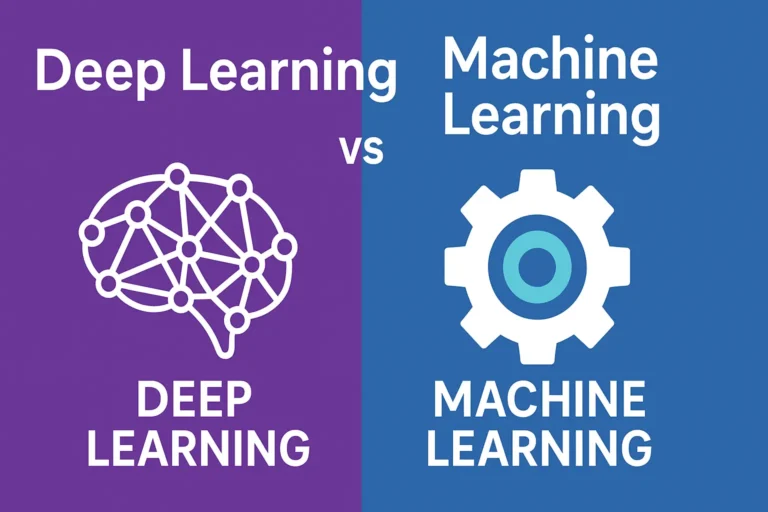
Infographic comparing Deep Learning and Machine Learning with icons of a brain and a gear, highlighting the differences between the two AI approaches

Deep Learning vs Machine Learning: Key Differences You Must Know

Are you usually confused about the difference between deep learning and machine learning? You’re not alone! These terms are frequently used interchangeably, but they are not the same. Understanding the distinctions is essential whether you’re a beginner stepping into AI or a professional aiming to sharpen your expertise. Let’s break it down everything you need to know about deep learning vs machine learning in clear, simple terms. What is Machine Learning? Machine learning is essentially about teaching a computer to recognize patterns in data without explicitly coding every rule. Think of it as showing a child hundreds of pictures of cats and dogs until they can figure out which is which on their own. Key characteristics of machine learning: Types of Machine Learning What is Deep Learning? Deep learning is a subset of machine learning, but it takes inspiration from how the human brain works. It uses artificial neural networks with many layers (hence the word “deep”) to process information. Imagine how your brain processes visual input. It passes through multiple layers of neurons, each detecting different features. Deep learning functions in a very similar way. Key characteristics of deep learning: Deep Learning vs Machine Learning: The Core Differences 1. Data Requirements 2. Feature Engineering 3. Hardware Requirements 4. Interpretability 5. Training Time When to Use Machine Learning vs Deep Learning Choose Machine Learning When: Choose Deep Learning When: Real-World Applications Machine Learning Examples: Deep Learning Examples: The Performance Factor Here’s an important insight: machine learning often outperforms deep learning on smaller datasets. But as the data gets bigger, deep learning tends to take the lead. Think of it like this: Getting Started: Which Path Should You Take? If you’re just beginning your journey in AI, start with machine learning first. Here’s why: Once you’re comfortable, you can dive into deep learning with confidence. Future Trends: What’s Next? The boundary between machine learning and deep learning continues to blur. Some exciting trends include: Conclusion Both machine learning and deep learning play vital roles in the AI landscape. The right choice depends on your data, resources, and goals. The key is to define your problem clearly before picking a tool. Don’t fall into the trap of using deep learning just because it’s trendy sometimes the simplest machine learning algorithm is exactly what you need. So, what’s your experience with machine learning vs deep learning? Have you found one more effective in your projects? Share your thoughts, I’d love to hear them!

Deep Learning vs Machine Learning: Key Differences You Must Know Read More »

Scroll to Top