artificial intelligence

Generative AI

Simple 5-Step Roadmap to Build Your Own Generative AI

If you want to build your own AI? Not just use ChatGPT, but actually create one? I’ve been there, and let me tell you, it’s easier than you think if you follow the right path. Let me break it down into 5 clear steps that actually work. Learn the Basics Before you touch any code, you need to understand what you’re building. Understand: Easiest start: Take a beginner course (Udemy / Coursera / free YouTube). Look, I know “learn the basics” sounds boring, but trust me, skipping this is like trying to build a house without knowing what a hammer is. You don’t need a PhD, just solid foundations. Spend 2-3 weeks here. Watch videos during breakfast, code during lunch breaks, and practice in the evening. The goal isn’t perfection, it’s understanding enough not to feel lost in the next steps. My recommendation: For Python + PyTorch, there are tons of free YouTube crash courses that’ll get you up to speed fast. Choose a Base Model Here’s where beginners waste months: trying to train everything from zero. Instead of building everything manually: Training from scratch is expensive; fine-tuning is smarter. Think of it like cooking. You wouldn’t grow wheat from seeds to make bread, right? You’d buy flour and bake. Same logic here—start with a pretrained model and customize it. I started with LLaMA 2 7B because it runs on consumer GPUs. Check your hardware first: Pro tip: Hugging Face is your best friend. Browse their model hub, read the model cards, and pick one that fits your use case. Prepare Your Dataset Your AI is only as good as the data you feed it. Garbage in = garbage out. Steps: Example format: This step takes longer than you think. I spent 60% of my time just cleaning data on my first project. Remove broken text, fix encoding issues, filter out junk. Where to get data: Quality > Quantity. 1,000 high-quality examples beat 100,000 messy ones. Fine-Tune the Model This is where the magic happens. This is where your AI becomes yours. Use techniques like: Process: This is where your AI becomes yours. Here’s what actually happens: You take that base model and teach it your specific style, knowledge, or task. Want an AI that writes like you? Fine-tune it on your writing. Want a customer support bot? Fine-tune it on support conversations. Tools I use: Real talk: Your first fine-tuning will probably give weird results. That’s normal. Tweak your hyperparameters, adjust your dataset, try again. I went through 7 iterations before I got something decent. Watch for: Test, Deploy, and Iterate You’ve got a fine-tuned model. Now what? Test it thoroughly: Deploy it: Keep improving: The Harsh Truths Nobody Mentions Let me keep it real with you: Hardware matters. You’ll need a decent GPU or cloud credits. Google Colab free tier works for learning, but you’ll outgrow it fast. Budget $50-200/month for serious work. It will break. A lot. Out of memory errors, CUDA crashes, and weird tokenization issues. Google the error, check GitHub issues, ask in Discord communities. Everyone goes through this. Your first model will be underwhelming. It’ll be slow, give mediocre outputs, and you’ll wonder if you did something wrong. You probably didn’t—this is just part of the process. Data preparation is 70% of the work. Accept this now and save yourself frustration later. Resources to Get You Started Learning: Communities: Tools: Final Thoughts Building your own AI isn’t as scary as it sounds. Yes, there’s a learning curve. Yes, you’ll hit obstacles. But the feeling when you type something into your own AI and it responds intelligently? Absolutely worth it. A year ago, I couldn’t code. Now I’ve built and deployed three custom LLMs. If I can do it, you definitely can.

Simple 5-Step Roadmap to Build Your Own Generative AI Read More »

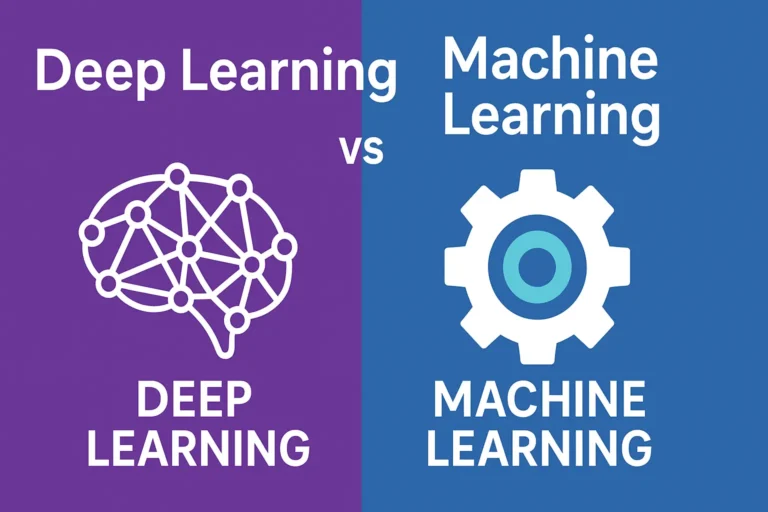
Infographic comparing Deep Learning and Machine Learning with icons of a brain and a gear, highlighting the differences between the two AI approaches

Deep Learning vs Machine Learning: Key Differences You Must Know

Are you usually confused about the difference between deep learning and machine learning? You’re not alone! These terms are frequently used interchangeably, but they are not the same. Understanding the distinctions is essential whether you’re a beginner stepping into AI or a professional aiming to sharpen your expertise. Let’s break it down everything you need to know about deep learning vs machine learning in clear, simple terms. What is Machine Learning? Machine learning is essentially about teaching a computer to recognize patterns in data without explicitly coding every rule. Think of it as showing a child hundreds of pictures of cats and dogs until they can figure out which is which on their own. Key characteristics of machine learning: Types of Machine Learning What is Deep Learning? Deep learning is a subset of machine learning, but it takes inspiration from how the human brain works. It uses artificial neural networks with many layers (hence the word “deep”) to process information. Imagine how your brain processes visual input. It passes through multiple layers of neurons, each detecting different features. Deep learning functions in a very similar way. Key characteristics of deep learning: Deep Learning vs Machine Learning: The Core Differences 1. Data Requirements 2. Feature Engineering 3. Hardware Requirements 4. Interpretability 5. Training Time When to Use Machine Learning vs Deep Learning Choose Machine Learning When: Choose Deep Learning When: Real-World Applications Machine Learning Examples: Deep Learning Examples: The Performance Factor Here’s an important insight: machine learning often outperforms deep learning on smaller datasets. But as the data gets bigger, deep learning tends to take the lead. Think of it like this: Getting Started: Which Path Should You Take? If you’re just beginning your journey in AI, start with machine learning first. Here’s why: Once you’re comfortable, you can dive into deep learning with confidence. Future Trends: What’s Next? The boundary between machine learning and deep learning continues to blur. Some exciting trends include: Conclusion Both machine learning and deep learning play vital roles in the AI landscape. The right choice depends on your data, resources, and goals. The key is to define your problem clearly before picking a tool. Don’t fall into the trap of using deep learning just because it’s trendy sometimes the simplest machine learning algorithm is exactly what you need. So, what’s your experience with machine learning vs deep learning? Have you found one more effective in your projects? Share your thoughts, I’d love to hear them!

Deep Learning vs Machine Learning: Key Differences You Must Know Read More »

Scroll to Top