Async Programming

Why Every Modern App Needs Composite APIs

Why Every Modern App Needs Composite APIs

Look, I’ll tell you the truth. When I first learned about “composite APIs,” I assumed it was just another catchphrase used by consultants to sound intelligent. However, I completely changed my mind after developing a few production apps and facing the nightmare of handling numerous API calls on the frontend. Let me tell you why composite APIs might just save your sanity (and your app’s performance). What Even Is a Composite API? Before we dive deep, let’s get on the same page. A composite API is basically an API endpoint that combines data from multiple sources or services into a single response. Instead of your frontend making 5 different API calls to get user profile, their posts, followers, notifications, and settings, you make ONE call to a composite endpoint that handles all that orchestration on the backend. Think of it like ordering a combo meal at a restaurant. You could order a burger, fries, and a drink separately, wait for each one, and pay three times. Or you could just order “Combo #3” and get everything at once. That’s essentially what composite APIs do for your app. The Problem They Actually Solve Here’s a real scenario I faced last year. We were building a dashboard for a SaaS app, and the homepage needed to show: Each of these lived in a different microservice. Our initial approach? Make 5 API calls from the React frontend. The result? A janky, slow-loading page with components popping in one by one like some weird progressive rendering experiment gone wrong. The problems with this approach: Let Me Show You: A FastAPI Example Okay, enough theory. Let’s build something real. Here’s a composite API endpoint using FastAPI that aggregates user dashboard data: What Makes This Powerful Notice a few things about this implementation: 1. Concurrent requests: We use asyncio.gather() to fire off all requests at the same time. Instead of waiting 200ms for each of 4 requests (800ms total), we wait for the slowest one, which might only be 250ms. 2. Graceful degradation: If the billing service is down, we don’t blow up the entire response. We return what we can and mark what’s missing. Your frontend can handle this elegantly. 3. Single round trip: The frontend makes ONE request and gets everything. This is massive for mobile users on flaky connections. 4. Business logic on the backend: The logic about how to combine, transform, and enrich this data lives on the server where it belongs, not scattered across your React components. Real-World Benefits I’ve Seen After implementing composite APIs in our app, we measured: When NOT to Use Composite APIs Look, composite APIs aren’t always the answer. Here’s when you should think twice: Don’t use them when: Be careful with: Some Practical Tips Here’s what I’ve learned building these in production: 1. Timeout strategically: Set aggressive timeouts. If a service takes more than 2 seconds, something’s wrong. 2. Add circuit breakers: If a downstream service keeps failing, stop calling it for a while. 3. Cache aggressively: Composite responses are perfect candidates for caching. Slap a Redis cache in front and watch your backend relax. 4. Monitor everything: Track which downstream services are slow or failing. You’ll thank yourself later. 5. Document what data is optional: Make it clear to frontend devs which fields might be null. The Bottom Line Composite APIs aren’t just a nice-to-have—they’re becoming essential for modern apps. As we move toward microservices and distributed systems, the frontend shouldn’t have to become an orchestration layer. That’s not its job. Your backend should expose clean, purpose-built endpoints that give the frontend exactly what it needs in one shot. Your users will notice the difference (faster loads, fewer errors), and your developers will thank you (simpler code, fewer bugs). Start small. Pick one page in your app that makes multiple API calls and create a composite endpoint for it. Measure the before and after. I bet you’ll be hooked. Have you implemented composite APIs in your projects? What patterns have worked for you? I’d love to hear about it in the comments below.

Why Every Modern App Needs Composite APIs Read More »

FastAPI Python web framework for high-performance API development

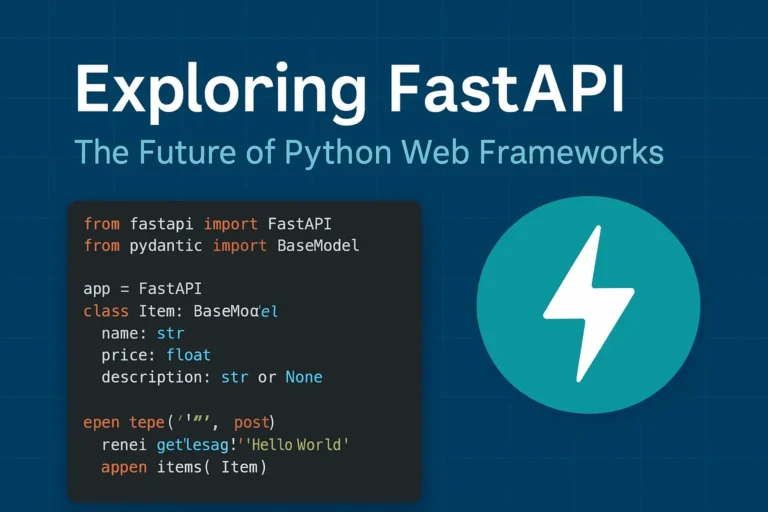
Exploring FastAPI: The Future of Python Web Frameworks

Why FastAPI is Taking the Python World by Storm In the rapidly evolving of Python web development, FastAPI has emerged as a game changing framework that’s reshaping how developers build modern APIs. Since its release in 2018, this innovative framework has gained massive adoption among developers worldwide, and for good reason. FastAPI combines the best of modern Python features with exceptional performance, making it an ideal choice for building production-ready APIs. Whether you’re a seasoned Python developer or just starting your web development journey, understanding FastAPI’s capabilities is crucial for staying ahead in today’s competitive development environment. What Makes FastAPI Special? Lightning-Fast Performance FastAPI lives up to its name by delivering exceptional speed that rivals frameworks written in Go and Node.js. Built on top of Starlette and Pydantic, FastAPI leverages Python’s async capabilities to handle thousands of concurrent requests efficiently. Performance benchmarks consistently show FastAPI outperforming traditional Python frameworks like Django and Flask by significant margins, making it perfect for high-traffic applications and microservices architectures. Automatic API Documentation One of FastAPI’s most beloved features is its automatic generation of interactive API documentation. Using the OpenAPI standard, FastAPI creates beautiful, interactive documentation that developers can use to test endpoints directly in the browser. This feature eliminates the tedious task of manually maintaining API documentation and ensures your documentation is always up-to-date with your code. Type Hints and Validation FastAPI leverages Python’s type hints to provide automatic request and response validation. This means fewer bugs, better IDE support, and more maintainable code. The framework uses Pydantic models to ensure data integrity and provide clear error messages when validation fails. Key Features That Set FastAPI Apart Modern Python Standards FastAPI is built with modern Python in mind, fully supporting: Built-in Security Features Security is paramount in modern web applications, and FastAPI provides robust built-in security features including: Developer Experience FastAPI prioritizes developer productivity with features like: Real-World Use Cases Microservices Architecture FastAPI excels in microservices environments due to its lightweight nature and fast startup times. Companies like Uber, Netflix, and Microsoft have adopted FastAPI for various microservices in their architecture. Machine Learning APIs The data science community has embraced FastAPI for deploying machine learning models as APIs. Its async capabilities and performance make it ideal for handling ML inference requests at scale. Traditional Web APIs From simple CRUD operations to complex business logic, FastAPI handles traditional web API development with elegance and efficiency. Getting Started with FastAPI Here’s a simple example of a FastAPI application: from fastapi import FastAPI from pydantic import BaseModel app = FastAPI() class Item(BaseModel): name: str price: float description: str = None @app.get(“/”) async def root(): return {“message”: “Hello World”} @app.post(“/items/”) async def create_item(item: Item): return {“item”: item} This simple example demonstrates FastAPI’s clean syntax and automatic validation through Pydantic models. FastAPI vs. Other Python Frameworks FastAPI vs. Django While Django remains excellent for full-stack web applications, FastAPI shines in API-first development with superior performance and modern async support. FastAPI vs. Flask Flask’s simplicity is appealing, but FastAPI offers better performance, automatic documentation, and built-in validation without sacrificing ease of use. FastAPI vs. Django REST Framework For pure API development, FastAPI provides better performance and developer experience compared to Django REST Framework, though DRF remains strong for Django-integrated projects. Best Practices for FastAPI Development Structure Your Project Organize your FastAPI project with clear separation of concerns: Performance Optimization Maximize your FastAPI application’s performance by: Testing and Documentation Ensure robust applications by: The Future of FastAPI FastAPI continues to evolve with regular updates and new features. The framework’s roadmap includes enhanced WebSocket support, improved performance optimizations, and better integration with modern deployment platforms. The growing ecosystem around FastAPI, including tools like FastAPI Users for authentication and FastAPI Cache for caching, demonstrates the framework’s bright future in Python web development. Conclusion: Is FastAPI Right for Your Next Project? FastAPI represents a significant leap forward in Python web development, combining high performance with developer-friendly features. If you’re building APIs that require speed, scalability, and maintainability, FastAPI should be at the top of your consideration list. The framework’s modern approach to Python development, combined with its excellent documentation and growing community support, makes it an excellent choice for both new projects and migrating existing applications. Whether you’re building microservices, machine learning APIs, or traditional web services, FastAPI provides the tools and performance needed to succeed in today’s competitive development landscape. If you like, please comment below for FastAPI’s more blogs:

Exploring FastAPI: The Future of Python Web Frameworks Read More »

Scroll to Top